
Introduction
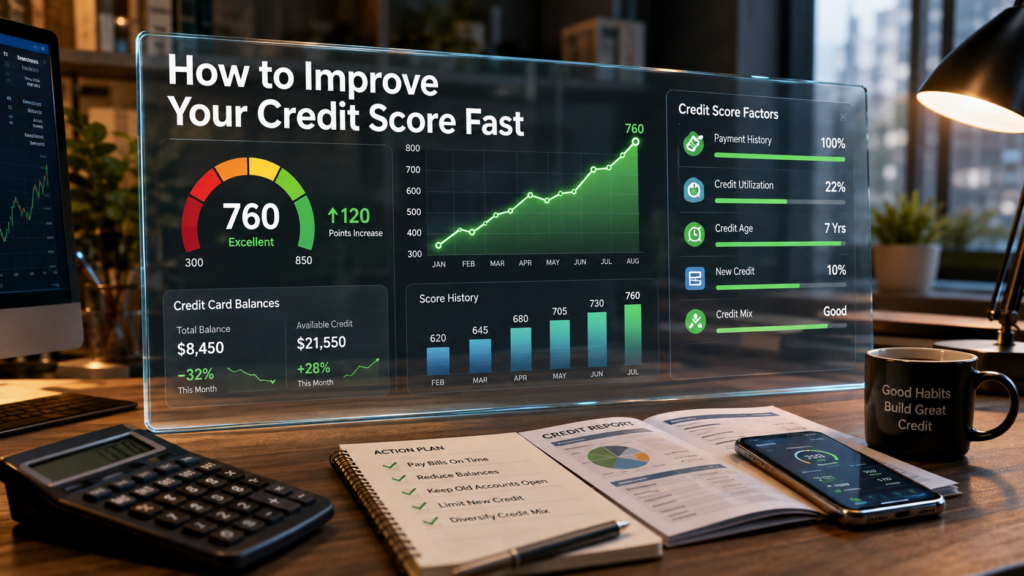
If your credit score is lower than you want, you may be wondering how to improve your credit score fast without waiting years to see results. The good news is that some credit improvements can happen relatively quickly when you focus on the factors that matter most. Paying down revolving balances, correcting inaccurate information, and establishing a consistent payment routine can all help put your credit profile in a stronger position.
However, there is no legitimate overnight credit-score fix. Your score is based on information in your credit reports, and different scoring models can react differently to the same action. For example, FICO says its scores generally consider payment history, amounts owed, length of credit history, new credit, and credit mix. Payment history represents 35% and amounts owed represents 30% in the commonly described FICO scoring model.
This guide explains how to improve your credit score fast using practical strategies you can start today. It also explains common mistakes to avoid, how long improvements may take, and how to create a simple credit-improvement plan for 2026.
How to Improve Your Credit Score Fast: Start With the Biggest Factors
Before making random changes to your finances, understand what actually influences your credit score.
For a typical FICO Score, the major categories are:
- Payment history — 35%
- Amounts owed — 30%
- Length of credit history — 15%
- New credit — 10%
- Credit mix — 10%
These percentages are useful general guidelines, but your individual score can respond differently depending on your complete credit profile.
That means you should prioritize the areas that can make the most meaningful difference rather than opening several new accounts or using questionable credit-repair services.
If you want to learn how to improve your credit score fast, begin with payment history and credit utilization.
1. Pay Every Bill on Time
The first and most important answer to how to improve your credit score fast is simple: stop missed payments from happening.
Payment history is the largest category in the commonly described FICO scoring model. A history of paying accounts on time demonstrates that you can manage borrowed money responsibly.
Even if you cannot pay your entire credit card balance, making at least the required minimum payment by the due date can help you avoid a new late payment.
Make on-time payments easier
Consider setting up:
- Automatic minimum payments
- Calendar reminders
- Bank alerts
- Text or email payment notifications
- A monthly bill-payment routine
If you have already missed payments, don’t assume your credit is permanently damaged. Get the account current and continue making payments on time. Older negative information generally has less impact than recent negative information.
The goal is to create a long-term pattern of reliable payments.
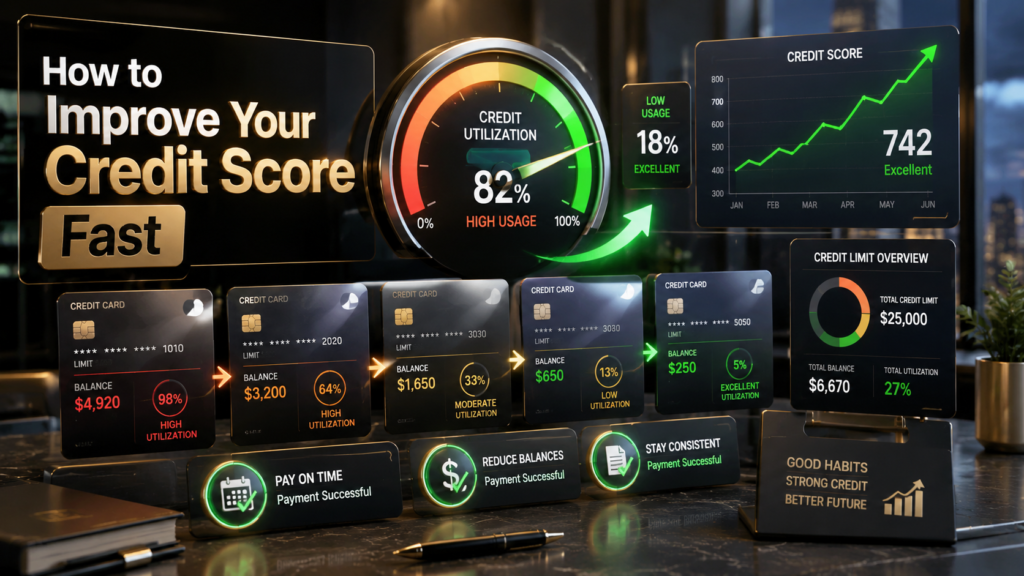
2. Lower Your Credit Utilization
If you’re searching for how to improve your credit score fast, lowering credit card utilization is one of the strategies worth examining first.
Credit utilization is the amount of revolving credit you’re using compared with your available credit.
For example, suppose you have:
- Total credit limit: $10,000
- Credit card balances: $4,000
- Utilization: 40%
If you reduce your balances to $2,000, your utilization falls to 20%.
Lower utilization generally presents less risk to scoring models than being close to your credit limits. CFPB notes that experts commonly advise keeping credit use below 30%, while some recommend even lower utilization.
Why utilization matters
FICO’s “amounts owed” category represents 30% of the commonly described FICO Score calculation. Credit utilization is an important part of that category.
If you can reduce your balances without taking on new debt, this may be one of the more practical ways to potentially improve your score relatively quickly.
3. Pay Down Credit Card Balances Before the Statement Date
Paying your credit card in full every month is excellent for avoiding interest, but there is another timing detail worth understanding.
Credit card companies may report balances to credit reporting companies at particular times. Therefore, your credit report can sometimes show a balance even when you subsequently pay the card in full. CFPB explains that a score calculated while a high balance is reported can be affected even if you pay that balance shortly afterward.
If you’re trying to learn how to improve your credit score fast, consider monitoring your statement closing dates and paying down balances before the balance that gets reported becomes unnecessarily high.
Example
Imagine your card has:
- $5,000 credit limit
- $2,500 current balance
That’s 50% utilization.
If you pay $1,500 before the relevant balance is reported, the reported balance could potentially be much lower.
The exact reporting timing varies by creditor, so don’t assume every lender reports on the same date.
4. Check Your Credit Reports for Errors
Sometimes the fastest legitimate credit improvement comes from correcting information that should not be there in the first place.
Your credit reports can contain information such as:
- Credit card accounts
- Loans
- Payment history
- Credit inquiries
- Account balances
- Collection accounts
- Personal identifying information
Look carefully for accounts you don’t recognize, incorrect payment information, duplicate accounts, incorrect balances, or accounts that should have been closed.
CFPB recommends checking your credit reports and disputing inaccurate information with the credit reporting company and the company that supplied the information.
Where to get your reports
For U.S. consumers, the official federally authorized source is AnnualCreditReport.com. CFPB identifies it as the source for obtaining credit reports from the nationwide credit reporting companies.
Important: Only dispute information that is actually inaccurate. Legitimate negative information generally cannot simply be removed because you dislike it.
5. Dispute Inaccurate Negative Information
Finding an error is only the first step. If something on your report is inaccurate, take action.
For example, suppose your report says you missed a payment but you have documentation showing the payment was made on time. You can dispute the information with the appropriate credit reporting company and the business that furnished the information.
Keep copies of:
- Statements
- Payment confirmations
- Correspondence
- Account records
- Other supporting documents
The stronger your documentation, the easier it can be to explain the problem.
This is one reason checking your reports is an important part of understanding how to improve your credit score fast.
6. Don’t Close Old Credit Cards Without a Reason
Closing an old credit card can sometimes seem like a smart financial move, especially if you don’t use it.
But closing an account can have unintended consequences.
For example, if closing a card reduces your available revolving credit, your overall utilization could rise. CFPB specifically warns that closing accounts and moving balances onto another card can hurt your score when it causes a higher percentage of available credit to be used.
Before closing an old card, consider:
- Annual fee
- Credit limit
- Account age
- Current balance
- Utilization impact
- Whether the card encourages unnecessary spending
If a card has no annual fee and isn’t causing problems, keeping it open may sometimes be worth considering. But personal circumstances vary, so don’t keep an account open if doing so creates financial problems.
7. Avoid Applying for Too Much New Credit
Another important part of how to improve your credit score fast is knowing what not to do.
Applying for several credit cards or loans within a short period can create multiple hard inquiries and may signal increased credit-seeking behavior.
FICO identifies new credit as 10% of its commonly described scoring model. It also notes that opening several new accounts quickly can be particularly impactful for people with shorter credit histories.
Instead of multiple applications
Before applying, ask:
- Do I actually need this account?
- Will the new account solve a real financial need?
- Can I comfortably manage another monthly payment?
- Have I compared the fees and interest rate?
- Is my current credit profile strong enough for the product?
Don’t apply for credit simply because a store offers a small discount.
8. Keep Older Accounts Open When Appropriate
The length of your credit history can also influence your score.
FICO’s model considers the age of your oldest account, the age of your newest account, and the average age of your accounts. Length of credit history represents 15% of the commonly described FICO calculation.
This means building a strong credit profile usually requires patience.
You can’t instantly create ten years of credit history.
However, you can avoid unnecessarily shortening your credit history by carefully considering whether closing an older account is actually necessary.
9. Pay Off High-Interest Debt Strategically
High-interest debt can make credit improvement difficult because large interest charges can keep balances high.
If you’re carrying balances across several cards, consider creating a repayment strategy.
Debt avalanche
With the debt avalanche approach, you generally prioritize the debt with the highest interest rate while maintaining required payments on other debts.
This can reduce interest costs over time.
Debt snowball
With the debt snowball method, you focus on paying off the smallest balance first while continuing required payments on other debts.
This can provide psychological motivation because you eliminate individual balances faster.
Neither strategy magically changes your credit score. The important part is consistently reducing debt while maintaining on-time payments.
As revolving balances fall, your credit utilization may also improve.
10. Don’t Carry a Balance Just to Build Credit
One of the most common credit myths is that you need to carry a balance from month to month to achieve a good credit score.
You don’t need to pay credit card interest to demonstrate responsible credit management.
CFPB specifically states that carrying a credit card balance is not necessary for a good credit score, and paying the balance in full can be beneficial.
A better approach is to:
- Use credit responsibly
- Pay on time
- Keep balances manageable
- Avoid unnecessary interest
- Maintain low utilization
If you can comfortably pay your statement balance in full, there is generally no reason to intentionally carry debt just for your credit score.
11. Consider Credit-Building Products Carefully
If you have limited credit history or are rebuilding credit, certain products may help establish a positive payment record.
Examples can include:
- Secured credit cards
- Credit-builder loans
- Certain financial products that report payments to credit bureaus
CFPB notes that secured credit cards and some credit-building products can help consumers establish or rebuild credit when payments are reported to the nationwide credit reporting companies.
But don’t open an account simply because it claims to “boost” your score.
Check:
- Fees
- Interest rate
- Reporting practices
- Deposit requirements
- Terms and conditions
- Whether the account fits your budget
The goal is to create positive credit history—not to collect unnecessary accounts.
How to Improve Your Credit Score Fast in 30 Days
If you want a practical action plan, start with these steps.
Week 1: Review your credit
- Get your credit reports.
- Check every account.
- Look for inaccurate information.
- Review your credit card balances.
- Identify accounts with missed payments.
- Write down your current credit limits.
Week 2: Reduce revolving balances
Focus available cash toward high-utilization credit cards while keeping required payments current.
Calculate your utilization:
Credit Utilization = Total Credit Card Balances ÷ Total Credit Limits × 100
For example:
$2,000 ÷ $10,000 × 100 = 20% utilization
Lower utilization is generally better than being close to your limits, although there is no single utilization percentage that guarantees a particular score.
Week 3: Automate payments
Set up automatic payments or reminders so you don’t accidentally miss a due date.
If possible, pay the statement balance in full to avoid unnecessary interest.
Week 4: Stop unnecessary applications
Avoid opening several new accounts simply to experiment with your credit profile.
Instead, allow your existing positive payment history and lower balances to work over time.
How Long Does It Take to Improve Your Credit Score?
There is no universal timeline.
The speed of improvement depends on why your score is low and what information appears on your credit reports.
For example:
High credit utilization:
A reduction in reported balances may have a relatively quick effect once the lower balances are reported.
Credit report error:
Correcting inaccurate information can potentially help once the reporting information is updated.
Recent missed payment:
Recovery generally takes longer because you need to establish a new pattern of on-time payments.
Short credit history:
Time is required because you cannot instantly create a long borrowing history.
Serious negative information:
Recovery can take significantly longer.
CFPB emphasizes that rebuilding credit takes time and that there are no legitimate shortcuts or secret methods that instantly erase accurate negative information.
Can You Improve Your Credit Score 100 Points Fast?
It is possible for some people to see significant score changes, but nobody can honestly guarantee a 100-point increase in a specific timeframe.
The potential improvement depends on your starting score and the information currently affecting it.
For example, someone with very high credit utilization may have more immediate room for improvement after paying down balances. Someone with several recent serious delinquencies may need much more time.
This is why effective credit improvement starts with identifying the specific factors hurting your profile.
Don’t trust anyone promising a guaranteed 100-point increase.
What Hurts Your Credit Score the Most?
Several behaviors can negatively affect your credit profile.
Missing payments
Because payment history is such an important FICO category, late payments can have a meaningful impact.
Maxing out credit cards
High utilization can indicate that you’re relying heavily on available credit.
Applying for excessive new credit
Multiple applications and new accounts can affect the new-credit portion of your score.
Closing accounts without considering utilization
Reducing available credit can potentially increase your overall utilization.
Ignoring credit report errors
Incorrect negative information can make your credit profile look worse than it actually is.
Credit Score Mistakes to Avoid in 2026
When learning how to improve your credit score fast, avoid these common mistakes.
Mistake 1: Paying a credit-repair company to remove accurate information
Accurate negative information generally cannot legally be removed just because you pay someone.
CFPB warns consumers about credit-repair scams and explains that companies cannot legally remove accurate negative information from a credit report.
Mistake 2: Closing every credit card
Closing accounts without considering your total available credit can increase utilization.
Mistake 3: Applying for multiple cards at once
More accounts aren’t automatically better.
Mistake 4: Carrying debt for a higher score
You don’t need to pay interest to build good credit.
Mistake 5: Ignoring your credit reports
If you never review your reports, you may not notice inaccurate information.
Mistake 6: Expecting instant results
Some changes can appear relatively quickly, but rebuilding a damaged credit profile takes time.
How Credit Utilization Affects Your Score
Credit utilization deserves special attention because it can change as your balances change.
Suppose you have three credit cards:
| Card | Credit Limit | Balance |
|---|---|---|
| Card A | $5,000 | $1,000 |
| Card B | $3,000 | $600 |
| Card C | $2,000 | $400 |
| Total | $10,000 | $2,000 |
Your overall utilization is:
$2,000 ÷ $10,000 = 20%
Now imagine your balances rise to $7,500 while your total limits remain $10,000.
Your utilization becomes 75%.
That significant increase could make your credit profile look riskier to a scoring model.
FICO confirms that utilization is an important part of the amounts-owed category.
Should You Request a Higher Credit Limit?
A higher credit limit can potentially lower your utilization if your spending stays the same.
For example:
Before:
$2,000 balance ÷ $5,000 limit = 40%
After a limit increase:
$2,000 balance ÷ $10,000 limit = 20%
However, requesting a higher limit may involve a credit inquiry depending on the issuer.
More importantly, a higher limit should not become an excuse to spend more.
If you receive a higher limit but increase your balance proportionally, you may not gain the utilization benefit you expected.
Before requesting an increase, check your issuer’s terms and determine whether the request could involve a hard inquiry.
How to Improve Your Credit Score Fast Without Taking on More Debt
You don’t necessarily need another loan or credit card to improve your credit.
In many cases, the strongest approach is simply improving the accounts you already have.
Start by:
- Paying bills on time.
- Reducing credit card balances.
- Checking your reports.
- Disputing genuine errors.
- Avoiding unnecessary applications.
- Keeping existing accounts manageable.
- Creating a realistic debt repayment plan.
These steps can improve the quality of your existing credit profile without encouraging unnecessary borrowing.
How to Improve Your Credit Score Fast Before Applying for a Loan
If you’re planning to apply for a mortgage, auto loan, personal loan, or credit card, prepare before submitting an application.
30–60 days before applying
Review your credit reports.
Reduce revolving balances
Lower utilization can make your profile stronger.
Avoid unnecessary applications
Don’t create additional inquiries unless you actually need new credit.
Correct errors
Start disputes as soon as you identify inaccurate information.
Continue paying every account on time
Don’t sacrifice your payment history while trying to pay down another account.
The key is preparation rather than trying to manipulate your score at the last minute.
Does Checking Your Own Credit Score Hurt It?
Generally, checking your own credit score is considered a soft inquiry and does not have the same effect as applying for new credit.
You should feel comfortable monitoring your credit.
In fact, regular monitoring can help you identify suspicious accounts or incorrect information sooner.
The important distinction is between checking your own information and allowing a lender to make a hard inquiry as part of a credit application.
Does Paying Off a Credit Card Improve Your Credit Score?
Paying off a credit card can help your credit profile, particularly when it lowers your revolving utilization.
However, the exact score change varies from person to person.
CFPB explains that paying credit card balances and maintaining low utilization can contribute to stronger credit scores, while scores can be calculated at different times depending on the information being reported.
Also remember that paying off a card doesn’t necessarily mean you should immediately close it.
Consider the account’s fees, age, credit limit, and effect on your overall credit profile before deciding what to do next.
Does a Debit Card Build Credit?
Normally, using a debit card does not build traditional credit history because you’re spending money directly from your bank account rather than borrowing through a credit account.
CFPB specifically notes that using a debit card or paying cash does not establish the repayment history associated with credit accounts.
If you need to build credit, consider products specifically designed to report responsible payments to the credit reporting companies.
How to Build Credit From Scratch
If you don’t have much credit history, improving your score requires a slightly different approach.
You may consider:
- A secured credit card
- A credit-builder product
- Becoming an authorized user when appropriate
- Using a credit account responsibly
- Paying every bill on time
- Keeping balances low
- Avoiding excessive applications
The goal isn’t to borrow as much as possible.
The goal is to demonstrate that you can responsibly manage credit over time.
A Simple Credit Score Improvement Checklist
Use this checklist each month:
- Pay every credit account on time.
- Keep credit card balances under control.
- Monitor your credit utilization.
- Review your credit reports for errors.
- Dispute inaccurate information.
- Avoid unnecessary hard inquiries.
- Avoid opening multiple accounts quickly.
- Keep older accounts open when appropriate.
- Pay down expensive revolving debt.
- Avoid carrying a balance just to build credit.
- Review your progress monthly.
Frequently Asked Questions About How to Improve Your Credit Score Fast
How can I improve my credit score fast?
Start by paying every bill on time, reducing credit card utilization, checking your credit reports for errors, and avoiding unnecessary new credit applications. These are among the most practical steps for improving your credit profile.
What is the fastest way to raise a credit score?
If high credit utilization is currently hurting your score, reducing reported credit card balances may provide a relatively quick improvement once the lower balances are reported. Correcting genuine credit-report errors may also help if inaccurate negative information was affecting your score.
Can I raise my credit score in 30 days?
You may see changes within a month after certain information is updated, particularly if revolving balances fall or an error is corrected. However, there is no guaranteed 30-day increase because credit scores depend on individual credit profiles.
Is 30% credit utilization good?
Keeping utilization below 30% is a commonly cited guideline, but lower utilization can be better, and there is no universal percentage that guarantees a particular score. CFPB and FICO both emphasize that utilization is an important consideration.
Should I pay my credit card in full every month?
If you can afford to do so, paying your statement balance in full can help you avoid interest while maintaining responsible payment behavior. You do not need to carry a balance to build a good credit score.
Does paying off debt remove negative credit history?
Not necessarily. Paying a debt can improve your current financial position and may reduce balances, but accurate negative information may remain on a credit report for a period allowed under applicable reporting rules. CFPB says negative payment information can generally be reported for up to seven years.
How long does it take to rebuild bad credit?
There is no fixed timeline. It depends on the severity and recency of negative information, your current debt levels, and whether you establish consistent positive payment behavior going forward.
Can a credit-repair company guarantee a higher score?
You should be cautious about guarantees. No legitimate company can promise a specific credit-score increase, and accurate negative information cannot simply be erased because someone charges you a fee.
Final Thoughts: How to Improve Your Credit Score Fast
Learning how to improve your credit score fast is really about identifying the factors that are hurting your credit profile and addressing them in the right order.
Start with the basics: pay on time, reduce credit card utilization, check your reports, correct genuine errors, and avoid unnecessary new credit.
Don’t fall for promises of instant results or secret credit-repair techniques. A strong credit score is built through consistent financial behavior.
If your score is being hurt by high credit card balances, prioritize reducing those balances. If inaccurate information is damaging your report, investigate and dispute it. If missed payments are the problem, focus on creating an automatic system that keeps every account current.
Most importantly, remember that credit improvement is a process. Some changes can potentially show results relatively quickly, while others require months or years of consistent behavior.
The best strategy for how to improve your credit score fast is not to look for a shortcut. It’s to make the highest-impact changes first and then maintain them.
If you’re looking for ways to manage your money more effectively while improving your credit habits, check out our guide to the Best Credit Cards for Cash Back in 2026. Choosing the right credit card and using it responsibly can help you make the most of rewards while keeping your credit utilization under control.
Building savings is another important part of maintaining a healthier financial position. If you want to strengthen your emergency fund and make your money work harder, explore our guide to the 15 Best High-Yield Savings Accounts in 2026 for options worth considering.