
Introduction: Best Credit Cards for Cash Back in 2026
Finding the Best Credit Cards for Cash Back in 2026 can make everyday purchases more rewarding. Instead of simply spending money on groceries, gas, dining, subscriptions, travel, and household expenses, the right cash-back credit card can return a portion of that spending to you as rewards.
Cash-back cards have become popular because they are generally easier to understand than complicated travel-reward systems. Depending on the card, you may earn a flat percentage on every purchase, higher rewards in specific categories, or rotating bonus rewards throughout the year.
However, the best card for one person may not be the best choice for another. Someone who spends heavily on groceries may benefit from a different card than someone who wants a simple 2% cash-back card for everything. Likewise, frequent diners, travelers, families, Amazon shoppers, and people who use PayPal regularly may have different priorities.
In this guide, we explore the Best Credit Cards for Cash Back in 2026, explain what makes each card useful, and show you how to choose a card based on your spending habits.
Important: Credit-card offers, rewards, annual fees, welcome bonuses, APRs, and eligibility requirements can change. Always verify the current terms with the card issuer before applying.
What Is Cash Back on a Credit Card?
Cash back is a type of credit-card reward that returns a percentage of eligible purchases to the cardholder.
For example, if a card offers 2% cash back and you spend $1,000 on eligible purchases, you could earn $20 in rewards.
Some cards provide one flat rate on almost everything. Others offer higher rates for specific categories such as:
- Groceries
- Restaurants
- Gas stations
- Streaming services
- Travel
- Online shopping
- Drugstores
- Entertainment
- Rotating quarterly categories
Citi explains that cash-back programs can use flat-rate or tiered reward structures, while individual cards may also have different redemption options and spending limits.
The important point is that cash back is only valuable if the card’s rewards match your spending and you avoid paying unnecessary interest or fees.
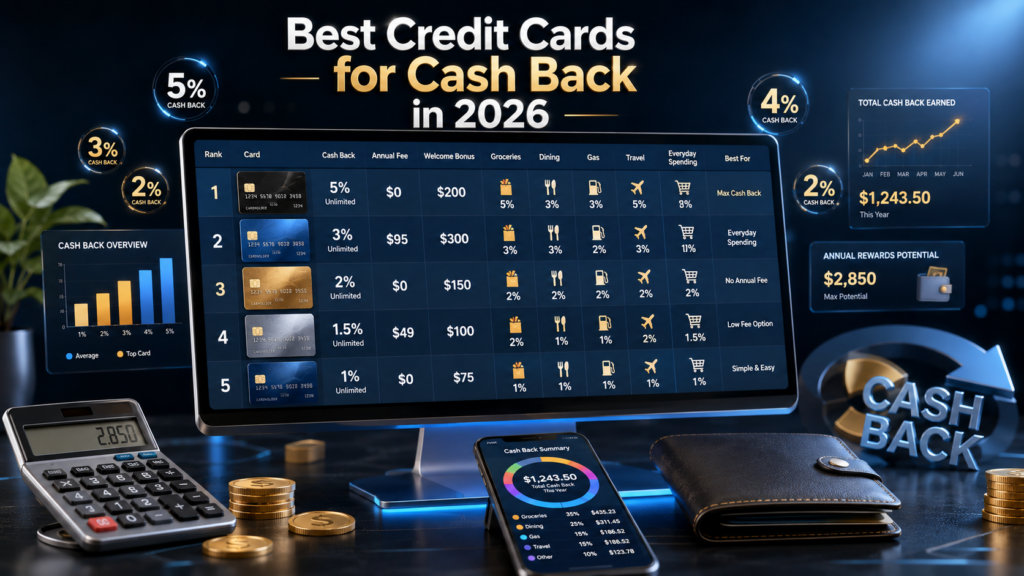
15 Best Credit Cards for Cash Back in 2026
The following cards stand out for different types of consumers. Rather than claiming one card is universally perfect, this list focuses on the particular strengths that make each option useful.
1. Wells Fargo Active Cash® Card — Best for Simple Flat-Rate Cash Back
The Wells Fargo Active Cash card is one of the strongest choices for people who want a straightforward cash-back system.
Its biggest advantage is simplicity. Instead of requiring you to remember different bonus categories, a flat-rate card can reward your everyday spending at the same rate.
NerdWallet lists Wells Fargo Active Cash as its pick for flat-rate cash back and notes that it has received its Best-Of recognition for simple cash back repeatedly from 2022 through 2026.
Why consider it?
- Simple rewards structure
- Useful for everyday purchases
- No need to track rotating categories
- Good option for people who dislike complicated reward systems
Best for:
Consumers who want a single cash-back card that is easy to use every day.
2. Citi Double Cash® Card — Best for Consistent 2% Cash Back
The Citi Double Cash card is another excellent option for consumers who prioritize simplicity.
Citi currently describes the card as offering unlimited 2% cash back on purchases: 1% when you buy and another 1% as you pay. It has no annual fee and no spending cap on the standard cash-back earning structure.
That makes it particularly attractive for people who want consistent rewards without activating categories.
Citi also states that eligible hotels, car rentals, and attractions booked through Citi Travel can earn a total of 5% cash back under the applicable terms.
Why consider it?
- Unlimited 2% cash back on purchases
- No category enrollment
- No annual fee
- Useful for everyday spending
- Additional travel rewards through Citi Travel
Best for:
People who want a simple, consistent cash-back strategy.
3. Chase Freedom Unlimited® — Best All-Around Cash-Back Card
Chase Freedom Unlimited is a strong choice for consumers who want elevated rewards in several everyday categories while still earning rewards on everything else.
Chase currently lists:
- 5% cash back on travel purchased through Chase Travel
- 3% on dining
- 3% at drugstores
- 1.5% on all other purchases
The card also has purchase protection and other benefits.
This combination makes it versatile for people whose spending is spread across different categories.
Why consider it?
- Strong dining rewards
- Strong drugstore rewards
- Elevated Chase Travel rewards
- 1.5% on other purchases
- No annual fee
Best for:
Consumers who want one card for multiple everyday spending categories.
4. Capital One Savor® — Best for Dining, Entertainment and Groceries
Capital One Savor is particularly interesting for people who spend a lot on food and entertainment.
Capital One currently lists 3% cash back at grocery stores and on dining and entertainment, along with 1% on other purchases. The card has a $0 annual fee under the currently listed offer.
Capital One also currently advertises a limited-time $250 cash bonus for eligible new cardholders who meet the stated spending requirement within the first three months. Offers can change, so verify the current terms before applying.
Why consider it?
- 3% at eligible grocery stores
- 3% on dining
- 3% on entertainment
- $0 annual fee
- Potential welcome bonus
Best for:
People who regularly spend money on restaurants, groceries, entertainment and other food-related purchases.
5. Discover it® Cash Back — Best for Rotating Bonus Categories
Discover it Cash Back can appeal to consumers who are willing to actively manage their rewards.
Unlike a simple flat-rate card, rotating-category cards can offer higher rewards on selected purchases during particular periods. NerdWallet identifies Discover it Cash Back as a strong option for quarterly categories and its matching bonus.
The trade-off is that you generally need to pay attention to the current categories and activation requirements.
Why consider it?
- Rotating bonus categories
- Potentially high rewards in selected categories
- Useful for consumers who actively manage credit-card rewards
Best for:
Reward enthusiasts who don’t mind tracking quarterly categories.
6. Chase Freedom Flex® — Best for Rotating Categories
Chase Freedom Flex can be another strong choice for people who want higher rewards in selected spending categories.
The card is designed around a combination of bonus categories and everyday rewards, making it useful for consumers who are comfortable managing multiple reward rates.
NerdWallet currently includes Chase Freedom Flex among its best cash-back cards, highlighting its quarterly categories and cash bonus potential.
Why consider it?
- Rotating bonus opportunities
- Multiple reward categories
- Useful for strategic spenders
- No annual fee
Best for:
People who are willing to monitor bonus categories to potentially increase their rewards.
7. Blue Cash Preferred® Card from American Express — Best for Families
Families and households can have very different spending patterns from single consumers. Grocery bills, transportation expenses and household purchases can represent a significant portion of monthly spending.
The Blue Cash Preferred card is frequently highlighted among leading cash-back options for families and households. NerdWallet currently identifies it as its pick for families and households.
The card may be particularly appealing when your household spending is concentrated in categories where it offers elevated rewards.
Why consider it?
- Designed around common household spending
- Potentially valuable for high grocery spenders
- Useful for families with substantial recurring expenses
Best for:
Families that can earn enough category rewards to justify the card’s fee structure.
8. Blue Cash Everyday® Card from American Express — Best for Popular Bonus Categories
If you want elevated rewards in common spending categories without necessarily choosing a premium card, Blue Cash Everyday can be worth considering.
NerdWallet currently identifies this card as a pick for popular 3% categories.
This can make it attractive for consumers whose spending naturally matches its bonus categories.
Why consider it?
- Useful everyday bonus categories
- No annual fee
- Good fit for consumers who want category-based rewards
Best for:
People whose grocery, gas and online-retail spending aligns with the card’s current reward structure.
9. Capital One Quicksilver Cash Rewards — Best for Simplicity
Not everyone wants to optimize several reward categories.
Capital One Quicksilver is designed around a simple cash-back model. Capital One currently lists the card at 1.5% cash back on every purchase with a $0 annual fee for the Good Credit version.
That simplicity can be valuable for people who want to use one card without thinking about which category is currently earning the highest rate.
Why consider it?
- 1.5% cash back on every purchase
- $0 annual fee
- Straightforward rewards
- Less category management
Best for:
Consumers who value simplicity over maximizing every possible percentage point.
10. Bank of America® Customized Cash Rewards — Best for Flexible Categories
Some consumers have spending patterns that don’t fit neatly into one standard category.
Bank of America’s Customized Cash Rewards card is included by NerdWallet among its 2026 cash-back recommendations, with the publication highlighting its adjustable category structure.
The ability to tailor the bonus category can make a card more useful when your spending priorities change.
Why consider it?
- Adjustable reward category
- Useful for targeted spending
- Potentially valuable for Bank of America customers
Best for:
People who want more control over where their bonus rewards are concentrated.
11. Synchrony Premier World Mastercard® — Best for Hassle-Free Rewards
Some consumers don’t want to constantly activate categories, track spending caps or manage multiple reward programs.
NerdWallet currently lists Synchrony Premier World Mastercard among its cash-back picks, highlighting its combination of a high reward rate and hassle-free redemption.
Why consider it?
- Simple reward experience
- Useful for consumers who prioritize easy redemption
- Less complicated than some rotating-category systems
Best for:
Consumers who want rewards without extensive category management.
12. PayPal Cashback Mastercard® — Best for Frequent PayPal Users
If PayPal is a major part of your online shopping routine, a card specifically designed around PayPal spending may deserve consideration.
NerdWallet currently includes the PayPal Cashback Mastercard among its recommended cash-back cards and identifies it as a pick for regular PayPal users.
Why consider it?
- Particularly useful for PayPal users
- Can complement online spending
- Straightforward cash-back approach
Best for:
Consumers who frequently use PayPal for eligible purchases.
13. Prime Visa — Best for Amazon Prime Shoppers
Frequent Amazon shoppers can potentially benefit from a card designed around Amazon-related spending.
NerdWallet currently identifies Prime Visa as its pick for Amazon Prime shoppers.
For a household that spends heavily through Amazon, category-specific rewards can potentially outweigh the benefits of a general flat-rate card.
Why consider it?
- Strong fit for Amazon-focused spending
- Useful for eligible Amazon purchases
- Can complement a broader cash-back strategy
Best for:
Amazon Prime members who spend significant amounts with Amazon and related eligible merchants.
14. Apple Card — Best for Apple Pay Power Users
Apple Card may be appealing to consumers who frequently use Apple Pay and prefer an integrated digital experience.
NerdWallet currently includes Apple Card among its cash-back recommendations and identifies it as a pick for Apple Pay power users.
Why consider it?
- Convenient Apple Wallet integration
- Useful for frequent Apple Pay users
- Straightforward cash-back experience
Best for:
Consumers who already rely heavily on Apple Pay and compatible Apple devices.
15. Discover it® Student Cash Back — Best for Eligible Students
Students who are beginning to build credit may have different needs from established cardholders.
A student cash-back card can potentially provide an opportunity to earn rewards while learning responsible credit management. Eligibility requirements, rates and reward terms vary, so students should review the current issuer terms carefully before applying.
Why consider it?
- Designed for eligible students
- Can introduce young consumers to cash-back rewards
- May help establish responsible credit habits when used correctly
Best for:
Eligible students who want a rewards card while building credit.
Quick Comparison of the Best Credit Cards for Cash Back in 2026
| Credit Card | Best For | Reward Style | Annual Fee* |
|---|---|---|---|
| Wells Fargo Active Cash | Flat-rate rewards | Simple cash back | $0 |
| Citi Double Cash | Consistent everyday rewards | 2% structure | $0 |
| Chase Freedom Unlimited | All-around spending | Tiered rewards | $0 |
| Capital One Savor | Dining & entertainment | Category rewards | $0 |
| Discover it Cash Back | Rotating categories | Quarterly rewards | $0 |
| Chase Freedom Flex | Bonus-category users | Rotating/tiered | $0 |
| Blue Cash Preferred | Families | Category rewards | Varies |
| Blue Cash Everyday | Everyday categories | Category rewards | $0 |
| Capital One Quicksilver | Simplicity | Flat-rate rewards | $0 |
| Bank of America Customized Cash | Flexible categories | Adjustable rewards | $0 |
| Synchrony Premier | Easy rewards | Cash back | $0 |
| PayPal Cashback Mastercard | PayPal users | PayPal-focused | $0 |
| Prime Visa | Amazon shoppers | Amazon-focused rewards | $0 |
| Apple Card | Apple Pay users | Apple Pay-focused | $0 |
| Student cash-back cards | Students | Category/flat rewards | Varies |
*Annual fees and other terms can change. Verify the current issuer terms before applying.
How to Choose the Best Credit Cards for Cash Back in 2026
Choosing a cash-back card should not be based solely on the highest advertised percentage.
A card offering 5% in one category isn’t automatically better than a card offering 2% everywhere if you rarely spend money in that category.
1. Look at Your Actual Spending
Start by reviewing the previous two or three months of spending.
Calculate approximately how much you spend on:
- Groceries
- Restaurants
- Gas
- Travel
- Online shopping
- Entertainment
- Streaming
- Drugstores
- Household expenses
- Other purchases
Once you understand your spending pattern, you can compare reward structures.
For example, someone spending $600 a month on groceries may value a grocery-focused card much more than someone who spends only $100.
2. Compare the Base Reward Rate
The base reward rate is particularly important because not every purchase will qualify for a bonus category.
A 2% flat-rate card can be extremely useful because you don’t have to think about where you’re spending.
Citi’s current Double Cash structure, for example, provides unlimited 2% cash back through 1% when purchasing and another 1% when paying.
3. Consider Annual Fees
An annual fee isn’t automatically bad.
A card with a $95 fee could still be worthwhile if its rewards and benefits produce more than $95 in additional value.
But if you don’t spend enough to recover the fee, a no-annual-fee alternative may be better.
Simple calculation:
Annual reward value − annual fee = estimated net reward value
This calculation helps prevent the mistake of choosing a card simply because its headline reward rate looks impressive.
Are No-Annual-Fee Cash-Back Cards Better?
For many consumers, yes—but not always.
No-annual-fee cards are attractive because you don’t have to spend a certain amount each year just to break even.
Cards such as Citi Double Cash and Capital One Savor currently have $0 annual fees under the listed terms.
However, a card with an annual fee may provide stronger rewards in categories where you spend heavily.
The right question isn’t:
“Does this card have an annual fee?”
Instead ask:
“Does the value I receive exceed the fee?”
Cash Back vs. Credit Card Interest
This is one of the most important considerations when choosing among the Best Credit Cards for Cash Back in 2026.
Cash back is only valuable when you use the card responsibly.
Suppose you earn $300 in cash-back rewards during a year but pay hundreds or thousands of dollars in interest because you carry a balance.
The interest can easily outweigh the rewards.
For this reason, cash-back rewards should be viewed as a bonus—not a reason to spend more money.
A better strategy is:
- Use the card for purchases you can afford.
- Track your spending.
- Pay your bill on time.
- Ideally pay the statement balance in full.
- Collect the rewards.
- Avoid unnecessary purchases simply to reach reward thresholds.
How Much Cash Back Can You Actually Earn?
Let’s consider a simple example.
Imagine you spend:
- $500 per month on groceries
- $300 per month on dining
- $200 per month on gas
- $500 per month on other purchases
Your annual spending would be:
$18,000
If you earned an average of 2% cash back on that spending:
$18,000 × 0.02 = $360
That means you could potentially earn approximately $360 in cash back.
But if a card offered higher rewards in your largest categories, your effective reward rate could potentially be higher.
This is why matching the card to your spending habits matters more than chasing a flashy promotional percentage.
Should You Have More Than One Cash-Back Credit Card?
Sometimes, yes.
A two-card strategy can be more effective than trying to make one card do everything.
For example, you could use:
Card A: A flat-rate card for general purchases.
Card B: A category card for groceries, dining or another major expense.
This strategy can provide stronger overall rewards without becoming excessively complicated.
However, adding more cards also creates more accounts to manage. If you are likely to miss payments or lose track of spending, simplicity may be more valuable than optimization.
How to Maximize Cash-Back Rewards in 2026
Use the Right Card for the Right Purchase
If one card offers a higher reward rate for dining and another offers a higher rate for groceries, use each card where it performs best.
But don’t make the system so complicated that you stop managing it effectively.
Pay Your Balance on Time
Late payments can result in fees, interest and potential damage to your credit profile.
Rewards should never become an excuse to carry debt you cannot afford.
Track Rotating Categories
If you use a card such as Discover it Cash Back or Chase Freedom Flex, check the current bonus categories regularly.
Rotating-category cards can be valuable, but only when you actually use their bonus categories.
Watch Spending Caps
Some high-reward categories have spending limits.
After reaching a certain threshold, purchases may earn the standard rate instead of the promotional rate.
Always read the current reward terms.
Don’t Overspend for a Welcome Bonus
A welcome bonus can be valuable, but only if you can naturally meet the spending requirement.
Spending $2,000 you didn’t need to spend just to receive a $200 bonus isn’t necessarily a financial win.
What Credit Score Do You Need for a Cash-Back Credit Card?
There is no single credit-score requirement for every cash-back card.
Issuers consider multiple factors, including credit history, income and existing obligations.
Generally, cards with richer rewards and stronger benefits may require stronger credit profiles, while some cards are designed for students or consumers who are building or rebuilding credit.
Before applying, check whether the issuer offers a prequalification or eligibility tool that uses a soft credit inquiry where applicable.
A prequalification isn’t a guarantee of approval, but it can help you understand your options before submitting a full application.
Is a 2% Cash-Back Card Good?
Yes.
A 2% cash-back card can be an excellent everyday card because it provides a strong reward rate without requiring category tracking.
For someone who wants simplicity, a flat 2% card may be more practical than a card offering 5% in a narrow category.
Citi’s Double Cash is one example: Citi currently advertises unlimited 2% cash back through its 1%-when-you-buy and 1%-when-you-pay structure.
The best choice ultimately depends on your spending habits and the card’s current terms.
Is 3% Cash Back Better Than 2%?
Usually, yes—but only if the 3% rate applies to purchases you actually make.
For example, suppose you spend $10,000 annually in a category.
At 2%:
$10,000 × 2% = $200
At 3%:
$10,000 × 3% = $300
The difference is $100.
But if the 3% card charges a large annual fee or has restrictive category rules, the 2% card could still produce better overall value.
Common Mistakes to Avoid
Mistake 1: Choosing a Card Only for the Welcome Bonus
A large bonus can be attractive, but the long-term reward structure matters too.
Mistake 2: Ignoring Annual Fees
Calculate whether the rewards justify the cost.
Mistake 3: Carrying a Balance for Rewards
Interest can destroy the value of your cash back.
Mistake 4: Applying for Too Many Cards
Every new account adds another payment deadline and another account to monitor.
Mistake 5: Ignoring Reward Caps
A high advertised percentage may apply only up to a certain spending limit.
Mistake 6: Forgetting Category Activation
Some rotating-category cards require activation. Missing that step can mean missing the bonus rewards.
Mistake 7: Spending More to Earn Rewards
Never spend unnecessary money simply because a credit card offers cash back.
Frequently Asked Questions About the Best Credit Cards for Cash Back in 2026
What is the best cash-back credit card in 2026?
There isn’t one universally best card. Wells Fargo Active Cash and Citi Double Cash are strong options for simple flat-rate rewards, while Chase Freedom Unlimited, Capital One Savor and category-based cards can be better for consumers whose spending matches their bonus categories. Current 2026 recommendations from NerdWallet and Forbes include many of these cards for different types of users.
What is the easiest cash-back credit card to use?
A flat-rate card is generally the easiest because you don’t need to remember rotating categories. Citi Double Cash and Capital One Quicksilver are examples of cards designed around relatively simple reward structures.
Is 2% cash back good?
Yes. A 2% unlimited cash-back rate is competitive for a general-purpose card and can be especially valuable because it applies broadly rather than only to selected categories.
Can cash back expire?
Reward-expiration rules depend on the issuer and card agreement. Chase states that its cash-back rewards generally don’t expire as long as the account remains open and not in default.
Should I get a cash-back card or travel card?
If you prefer simple rewards that can be used toward everyday expenses, cash back may be more convenient. If you travel frequently and understand points and miles, a travel card may potentially provide greater value.
Are cash-back rewards taxable?
Tax treatment can depend on how rewards are earned and the circumstances surrounding them. Many ordinary purchase-based credit-card rewards are generally treated differently from interest or investment income, but promotional payments and unusual situations can have different tax implications. Consult a qualified tax professional for advice about your specific circumstances.
Can I use two cash-back cards?
Yes. A two-card strategy can work well when each card has a different strength. For example, one card could provide a flat rate for general purchases while another provides higher rewards in groceries or dining.
Final Verdict: Best Credit Cards for Cash Back in 2026
The Best Credit Cards for Cash Back in 2026 aren’t necessarily the cards with the biggest advertised percentage. The best card is the one that fits your actual spending, charges reasonable fees, provides rewards you can realistically use, and helps you manage your finances responsibly.
For straightforward everyday spending, Wells Fargo Active Cash and Citi Double Cash deserve serious consideration. Citi currently advertises unlimited 2% cash back through its two-step earning structure, while Wells Fargo Active Cash is recognized by NerdWallet for simple flat-rate cash back.
For people who spend heavily on dining, entertainment and groceries, Capital One Savor can be particularly attractive because Capital One currently lists 3% cash back in those eligible categories.
For consumers looking for broader category rewards, Chase Freedom Unlimited offers a combination of travel, dining, drugstore and general-spending rewards.
And for people who enjoy actively optimizing their spending, cards such as Discover it Cash Back, Chase Freedom Flex, and other category-focused cards can provide opportunities to earn more when used strategically.
Ultimately, the smartest cash-back strategy is simple: choose a card that matches your spending, understand the terms, pay your balance responsibly, and never spend more just to earn rewards.
When comparing the Best Credit Cards for Cash Back in 2026, focus on the complete picture—reward rate, eligible categories, annual fee, spending limits, welcome offer, redemption options and your own spending habits. That approach can help you turn everyday purchases into meaningful rewards without allowing the pursuit of cash back to undermine your financial goals.
Comparing the Best Credit Cards for Cash Back in 2026 by Spending Category
Choosing among the Best Credit Cards for Cash Back in 2026 becomes much easier when you compare cards according to your actual spending habits. A card that looks average at first can become extremely valuable if its highest reward rate matches the purchases you make every week.
Instead of asking which credit card has the biggest advertised cash-back percentage, ask a more practical question:
Which card gives me the most useful rewards on the money I already spend?
For example, someone who spends heavily on restaurants may benefit from a dining-focused card. A household with large grocery bills may prefer a grocery rewards card, while someone who doesn’t want to track categories may be happier with a simple flat-rate card.
Best Credit Cards for Cash Back in 2026 for Everyday Purchases
Everyday spending is one of the most important areas to consider when comparing cash-back cards.
Many purchases don’t fall into special bonus categories. You may buy clothing, household supplies, electronics, personal-care products or other items throughout the year.
For this type of spending, a strong flat-rate card can be extremely useful.
Citi Double Cash
Citi Double Cash is designed around a straightforward earning structure. Citi currently advertises 2% cash back on purchases through 1% when you buy and another 1% when you pay. (citi.com)
This makes it particularly attractive for people who don’t want to remember rotating categories.
Wells Fargo Active Cash
Wells Fargo Active Cash is another popular choice for consumers who want simple rewards. NerdWallet currently recognizes it as a strong flat-rate cash-back option. (nerdwallet.com)
The biggest advantage of this type of card is convenience.
You can use it for ordinary purchases without constantly checking whether a transaction qualifies for a special category.
Best Credit Cards for Cash Back in 2026 for Groceries
Grocery spending can represent a major portion of a household’s annual budget.
If you spend hundreds of dollars every month at supermarkets, earning an elevated cash-back rate on groceries can potentially generate meaningful rewards over a year.
Capital One Savor
Capital One currently lists 3% cash back at eligible grocery stores, as well as 3% on dining and entertainment, subject to the card’s terms. (capitalone.com)
This makes Savor particularly interesting for households that combine grocery shopping with restaurant and entertainment spending.
For example, a person who spends:
- $500 per month on groceries
- $250 per month on restaurants
- $150 per month on entertainment
could have substantial spending in categories where elevated rewards may apply.
The important point is not to increase spending simply because a card offers rewards.
Use the card for purchases you would make anyway.
Best Credit Cards for Cash Back in 2026 for Dining
Dining is another category where specialized rewards can make a noticeable difference.
Restaurants, cafés, food delivery services and other dining purchases can add up quickly.
Chase Freedom Unlimited
Chase currently lists 3% cash back on dining, including eligible takeout and delivery purchases, along with other reward categories. (chase.com)
This can make Freedom Unlimited attractive for consumers who eat out regularly.
Capital One Savor
Capital One also positions Savor around dining and entertainment, currently listing 3% cash back on eligible dining purchases. (capitalone.com)
Which type of card is better?
If dining is one of your largest expenses, compare:
- Reward percentage
- Annual fee
- Welcome bonus
- Redemption options
- Other bonus categories
- Whether restaurants are classified as eligible purchases
The highest percentage isn’t necessarily the best overall value.
Best Credit Cards for Cash Back in 2026 for Gas
Drivers can spend thousands of dollars per year on fuel.
If you have a long commute, travel frequently by car or manage multiple vehicles, gas rewards can become an important part of your cash-back strategy.
However, don’t automatically choose a card just because it advertises a high gas reward.
First calculate your annual spending.
Example
Suppose you spend $250 per month on gas.
That’s:
$250 × 12 = $3,000 per year
A 1% difference in rewards would equal:
$3,000 × 1% = $30
That means a small difference in the cash-back rate may not be worth paying a significant annual fee.
This is why calculating your actual dollar benefit is more useful than simply comparing percentages.
Best Credit Cards for Cash Back in 2026 for Online Shopping
Online shopping has become a major part of household spending.
Consumers may use online marketplaces for:
- Electronics
- Clothing
- Household supplies
- Groceries
- Gifts
- Beauty products
- Office supplies
- Subscription services
A category-focused card can potentially provide better rewards than a general-purpose card when your online spending is high.
Prime Visa
For eligible Amazon Prime members, Prime Visa can be particularly relevant because it is designed around Amazon-related spending.
NerdWallet currently identifies Prime Visa as its cash-back pick for Amazon Prime shoppers. (nerdwallet.com)
Before applying, check the current Amazon and issuer terms to understand which purchases qualify.
Best Credit Cards for Cash Back in 2026 for Travel
Cash-back cards aren’t only useful for everyday household purchases.
Some cash-back cards provide elevated rewards for travel booked through specific issuer portals.
Chase Freedom Unlimited
Chase currently lists 5% cash back on travel purchased through Chase Travel for Freedom Unlimited. (chase.com)
That can be useful for travelers who already use the Chase ecosystem.
However, consumers who travel frequently should also compare dedicated travel cards.
A travel card may offer benefits such as:
- Airport lounge access
- Travel credits
- Hotel benefits
- Airline benefits
- Transferable points
- Travel insurance
If your priority is simply receiving cash back, however, a cash-back card may be easier to understand.
Best Credit Cards for Cash Back in 2026 Without an Annual Fee
Annual fees can reduce the value of rewards.
For people who prefer predictable costs, no-annual-fee cards can be an attractive starting point.
Examples include several cards discussed in this guide, including:
- Citi Double Cash
- Wells Fargo Active Cash
- Chase Freedom Unlimited
- Capital One Savor
- Capital One Quicksilver
- Blue Cash Everyday
- Bank of America Customized Cash Rewards
Always verify the current terms because issuers can change fees, benefits and reward structures.
Why no annual fee matters
Suppose two cards generate approximately $250 in annual rewards.
Card A:
$250 rewards − $0 annual fee = $250 net value
Card B:
$250 rewards − $95 annual fee = $155 net value
The second card would need to provide additional value through higher rewards or benefits to justify the fee.
Best Credit Cards for Cash Back in 2026 for Families
Families often have larger and more varied expenses.
A typical household may spend money on:
- Groceries
- Gas
- Restaurants
- Streaming
- School-related purchases
- Household supplies
- Online shopping
- Travel
- Medical and pharmacy purchases
Because family spending can be substantial, even a small increase in the effective cash-back rate can make a difference.
Blue Cash Preferred
NerdWallet currently identifies Blue Cash Preferred from American Express as a strong cash-back option for families and households. (nerdwallet.com)
The card’s value should be evaluated based on the household’s eligible spending and its current annual fee.
A simple family calculation
Imagine a household spends $12,000 per year in a category earning an effective 4% reward rate.
Potential rewards:
$12,000 × 0.04 = $480
If another card earned 2% on the same spending:
$12,000 × 0.02 = $240
The difference is:
$240 per year
If the higher-reward card has an annual fee, subtract that fee to determine the real benefit.
Best Credit Cards for Cash Back in 2026 for Students
Students often need to prioritize credit-building over reward optimization.
A rewards card is useful only when the student can manage it responsibly.
The most important habits include:
- Paying bills on time.
- Keeping spending under control.
- Avoiding unnecessary debt.
- Understanding interest charges.
- Monitoring the account regularly.
A student should never spend extra money just to earn cash back.
For students who qualify, a student-oriented cash-back card can offer a way to earn rewards while developing responsible credit habits.
Best Credit Cards for Cash Back in 2026 for Beginners
Beginners often benefit from simplicity.
Managing several cards with different reward categories can become confusing.
If you’re new to credit cards, consider starting with one card that has:
- No annual fee
- Simple rewards
- Reasonable eligibility requirements
- Easy redemption
- Useful everyday categories
A flat-rate cash-back card can be especially attractive because you don’t need to memorize multiple bonus categories.
Once you understand how credit-card billing works, you can decide whether adding another card would genuinely improve your rewards.
How to Calculate Your Real Cash-Back Rate
Advertised reward rates don’t always tell the complete story.
Your effective cash-back rate considers your actual spending.
Use this simple formula:
Total cash-back rewards ÷ total eligible spending × 100 = effective cash-back percentage
Example
Suppose you spend $15,000 during a year and receive $300 in rewards.
Your effective rate is:
$300 ÷ $15,000 × 100 = 2%
This is more useful than looking at a card’s highest advertised category if most of your spending earns a lower base rate.
How Annual Fees Change Your Cash-Back Value
An annual fee can significantly affect the value of a rewards card.
Consider two cards.
Card A
- Annual spending: $20,000
- Average cash back: 2%
- Rewards: $400
- Annual fee: $0
Net value: $400
Card B
- Annual spending: $20,000
- Average cash back: 4%
- Rewards: $800
- Annual fee: $95
Net value: $705
In this example, Card B wins.
But if you only spent $5,000 annually:
Card A
$5,000 × 2% = $100
Card B
$5,000 × 4% = $200
After the $95 annual fee:
$200 − $95 = $105
The difference becomes only $5.
This demonstrates why the best card depends on your individual spending.
Should You Redeem Cash Back Immediately?
It depends on your financial goals and the issuer’s available redemption methods.
Some consumers prefer to redeem rewards regularly rather than allowing a large balance to accumulate.
Possible uses may include:
- Statement credits
- Bank deposits
- Checks
- Gift cards
- Other eligible redemption options
Before choosing a card, check the issuer’s current redemption rules.
A reward isn’t particularly useful if the redemption method doesn’t fit your preferences.
Statement Credit vs. Direct Deposit
Cash-back rewards may sometimes be redeemed as a statement credit or deposited into an eligible bank account, depending on the issuer.
Statement Credit
A statement credit reduces the amount you owe on your credit-card account.
Direct Deposit
A direct deposit can place the reward into an eligible bank account.
Neither method is automatically better for everyone.
If you want to use rewards to reduce your credit-card bill, a statement credit may be convenient.
If you want to move the money into savings, a deposit may be more useful when available.
How Welcome Bonuses Affect the Best Credit Cards for Cash Back in 2026
A welcome bonus can significantly increase first-year rewards.
For example, imagine a card offers a $200 bonus after you spend a specified amount during the introductory period.
If you were already planning to make those purchases, the bonus can provide additional value.
But you shouldn’t change your spending habits simply to qualify.
Before pursuing a welcome bonus, ask:
- Would I make these purchases anyway?
- Can I pay the balance in full?
- Is there an annual fee?
- What happens after the introductory period?
- Are there restrictions?
- Does the regular reward rate remain competitive?
The bonus is only one part of the card’s overall value.
Best Strategy for Maximizing Cash Back Without Overspending
The safest approach is to build your rewards strategy around your existing budget.
Don’t build your budget around your credit card.
For example:
Step 1: Set your monthly budget
Determine how much you can realistically spend.
Step 2: Identify your largest categories
Find your top three spending areas.
Step 3: Match cards to those categories
Look for cards that reward the purchases you already make.
Step 4: Use the cards consistently
Avoid unnecessary switching between too many accounts.
Step 5: Pay the statement balance
This can help prevent interest from reducing the value of your rewards.
Step 6: Review annually
Your spending may change over time.
A card that was ideal in 2026 may not remain your best option later.
Are Cash-Back Credit Cards Worth It?
For responsible cardholders, cash-back cards can be worthwhile.
But the rewards should be considered a secondary benefit.
The primary goal should be maintaining healthy financial habits.
If you pay your balances on time and avoid unnecessary interest, cash-back rewards can provide value on purchases you were already planning to make.
However, if rewards encourage you to spend beyond your budget, the card may become financially harmful.
The right cash-back card should fit into your financial system—not control it.
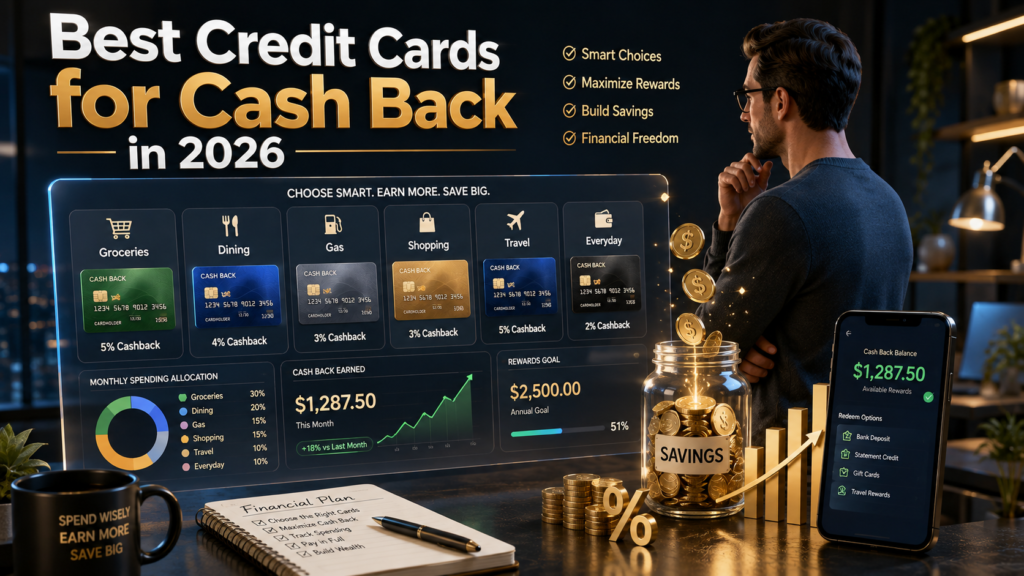
Final Thoughts on the Best Credit Cards for Cash Back in 2026
The Best Credit Cards for Cash Back in 2026 can be divided into several major categories.
For simple everyday rewards, flat-rate cards such as Citi Double Cash and Wells Fargo Active Cash are strong choices to research.
For people who spend heavily on dining, groceries and entertainment, Capital One Savor can be an appealing option based on its current reward structure.
For consumers who want multiple everyday bonus categories, Chase Freedom Unlimited offers a broader rewards structure.
For people who enjoy rotating categories, Discover it Cash Back and Chase Freedom Flex can be worth considering.
Families may want to evaluate Blue Cash Preferred, while Amazon Prime shoppers may find Prime Visa more relevant to their spending.
The most important lesson is that the best credit card isn’t necessarily the one with the highest advertised reward rate.
It is the card that provides the greatest net value after considering your actual spending, annual fees, reward limits, redemption options and responsible payment habits.
Before applying for any card, review the issuer’s current terms and conditions. Credit-card offers can change, and approval is never guaranteed.
If you approach cash-back rewards strategically, everyday spending can become an opportunity to earn additional value without making your financial life unnecessarily complicated.
Earning cash back is useful, but where you keep your savings matters too. After using the Best Credit Cards for Cash Back in 2026 to maximize everyday rewards, consider putting your emergency fund or short-term savings into a competitive high-yield account. Our guide to 15 Best High-Yield Savings Accounts in 2026 explains how to compare APYs, fees, minimum balances, FDIC insurance, and account accessibility.
Before applying for a cash-back credit card, create a realistic monthly spending plan. Our guide on How to Create a Monthly Budget That Actually Works explains how to track expenses, separate needs from wants, set spending limits, build savings, and manage debt.
Pingback: How to Improve Your Credit Score Fast: 11 Proven Strategies for 2026 - finoventry.com
Pingback: Best Investment Apps for Beginners in 2026: 10 Powerful Picks to Start Investing - finoventry.com