
If you’ve ever thought about investing but assumed you needed thousands of dollars to get started, you’re not alone. Many beginners believe investing is only for wealthy people or experienced traders. In reality, you can learn how to start investing with just $100 and begin building an investment habit without putting a huge amount of money at risk.
The first $100 probably won’t make you rich overnight, and that’s not the point. Your first investment is about getting started, learning how the market works, understanding risk, and creating a habit that you can continue for years.
Once you understand how to start investing with just $100, you can gradually increase the amount you invest as your income and confidence grow. The difference between starting today and waiting until you have $10,000 can be significant because time is one of the most valuable tools an investor has.
This guide explains how to start investing with just $100 in a practical, beginner-friendly way. We’ll look at where your money could go, how to choose an investment account, what mistakes to avoid, and how a small beginning can eventually become a much larger portfolio.
If you’re new to investing, the U.S. Securities and Exchange Commission’s Investor.gov investing basics guide is a useful place to learn about investment goals, risk, diversification, and long-term investing.
Can You Really Start Investing With Just $100?
Yes, you can.
One of the biggest changes in investing over the past several years has been the lower barrier to entry. Many investment platforms allow people to start with relatively small amounts of money. Some also offer fractional shares, meaning you can purchase part of a share instead of needing enough money to buy an entire share.
This makes how to start investing with just $100 a much more realistic question than it was in the past.
Imagine a stock costs $400 per share. If your investment platform supports fractional shares, you may be able to invest $20, $50, or $100 in that company without purchasing the entire share.
However, being able to start with $100 doesn’t mean you should expect extraordinary returns immediately.
If someone tells you that your $100 can become $10,000 in a few weeks with almost no risk, be extremely careful. High returns usually involve high risk, and guaranteed investment profits are a major warning sign.
A better way to think about how to start investing with just $100 is to treat your first investment as the beginning of a long-term financial habit.
Why Starting With $100 Can Be a Good Idea
There is a psychological benefit to starting small.
When you’re new to investing, putting $5,000 or $10,000 into the market can feel overwhelming. Every price movement can make you nervous.
Starting with $100 gives you an opportunity to learn without exposing a large amount of money.
You’ll discover what it feels like when an investment goes up.
You’ll also discover what it feels like when it goes down.
That experience matters.
Reading about market volatility is one thing. Watching your own investment move from $100 to $96 and then back to $102 gives you a completely different understanding of how markets behave.
This is one reason learning how to start investing with just $100 can be valuable even if the initial financial return is small.
You’re not only investing money. You’re investing in your financial education.
How to Start Investing With Just $100 Step by Step
If you’re ready to begin, don’t make the process more complicated than it needs to be.
Here’s a simple framework for how to start investing with just $100.
Step 1: Check Your Financial Situation
Before investing your $100, make sure you can actually afford to invest it.
If you need that money for rent, groceries, utilities, debt payments, or an upcoming emergency, keep it available instead.
Investments can lose value, sometimes at exactly the moment you need the money.
For example, suppose you invest your last $100 and your car suddenly needs a $100 repair. If the investment has fallen to $85, you might be forced to sell it at a loss.
That’s why the first rule of how to start investing with just $100 is simple: don’t invest money you genuinely need for short-term expenses.
Step 2: Define Your Investment Goal
Ask yourself why you’re investing.
Maybe you want to build wealth for retirement.
Maybe you’re saving for a long-term financial goal.
Maybe you simply want to learn how the stock market works.
Your goal matters because investing for six months is very different from investing for twenty years.
If you need the money soon, taking significant market risk may not be appropriate.
If you have a long time horizon, you may have more ability to tolerate temporary market declines.
Understanding your goal makes how to start investing with just $100 much easier because it gives you a reason behind every investment decision.
Step 3: Learn the Basic Investment Terms
You don’t need to become a financial expert before investing $100, but you should understand the basics.
Here are a few terms worth knowing.
Stock: A share of ownership in a company.
ETF: An exchange-traded fund that can hold a collection of stocks, bonds, or other assets.
Index Fund: A fund designed to track a particular market index.
Bond: A type of investment representing money lent to a government, company, or other issuer.
Diversification: Spreading money across different investments instead of relying on one asset.
Expense Ratio: An ongoing fee charged by a fund to cover its operating expenses.
Risk Tolerance: How much market volatility and potential loss you can reasonably handle.
Understanding these terms will make the process of how to start investing with just $100 much less confusing.
Where Should You Invest Your First $100?
There isn’t one investment that is automatically right for every beginner.
Your decision depends on your goals, risk tolerance, time horizon, location, and financial situation.
However, several common options are worth researching.
Broad-Market Index Funds
A broad-market index fund can provide exposure to many companies through one investment.
Instead of trying to pick the single company that will perform best, you can invest in a fund that follows a broader market.
This can be attractive to beginners because it provides diversification without requiring them to research dozens of individual companies.
If you’re researching how to start investing with just $100, broad index funds are one category worth understanding.
They still carry market risk, though. A broad market can fall, and your investment can lose value.
Diversification reduces concentration risk, but it doesn’t eliminate investment risk.
Exchange-Traded Funds
ETFs are another popular option.
Some ETFs track broad indexes, while others focus on specific sectors, industries, countries, or investment strategies.
Before buying an ETF, look at what it actually owns.
Two ETFs may sound similar but have very different holdings and risk levels.
Check:
- What assets the ETF holds
- Its expense ratio
- Its investment objective
- Its historical performance
- Its level of diversification
- Its volatility
- Any additional fees
Doing this research is an important part of learning how to start investing with just $100 responsibly.
Individual Stocks
You can also use $100 to purchase individual stocks if your brokerage supports fractional shares.
This can be exciting because you get direct exposure to companies you believe in.
But individual stocks generally carry more concentration risk.
If you put your entire $100 into one company and that company loses 30% of its value, your investment could fall to around $70.
If you instead invest across many companies through a diversified fund, the poor performance of one company may have less impact on the overall portfolio.
Individual stocks aren’t automatically bad. They simply require more research and can create more concentrated risk.
How Fractional Shares Make $100 More Useful
Fractional shares are especially important when discussing how to start investing with just $100.
Without fractional shares, beginners may feel limited by the price of individual stocks.
With fractional shares, your investment amount doesn’t have to equal the full share price.
For example, imagine these hypothetical stock prices:
- Company A: $450 per share
- Company B: $300 per share
- Company C: $175 per share
With fractional investing, you may be able to put $25 into Company A, $25 into Company B, and $25 into Company C rather than needing hundreds of dollars for complete shares.
You could then keep the remaining $25 available or put it into another investment.
The availability of fractional shares depends on the investment platform, so check the platform’s current rules before opening an account.
Should You Put All $100 Into One Investment?
You can, but you don’t necessarily have to.
For someone learning how to start investing with just $100, simplicity can sometimes be more useful than owning several unrelated investments.
For example, you could research one diversified index fund and invest the full $100.
Another investor might prefer dividing the money between two or three investments.
There is no universal allocation that works for everyone.
The important thing is to understand what you own and why you own it.
Don’t divide your $100 into ten different investments simply because you think having more investments automatically means you’re diversified.
A portfolio can become complicated without becoming better.
A Simple Example of Investing $100
Let’s say you have $100 available and your emergency savings and immediate expenses are already covered.
One possible example could be:
$70: Broad diversified fund
$20: Individual investment you’re researching
$10: Cash
Another person might choose:
$100: One diversified index fund
A different investor could decide:
$50: Broad-market ETF
$25: Bond fund
$25: Individual stock
These are examples rather than personal investment recommendations.
The right choice depends on the investor.
The main lesson is that how to start investing with just $100 doesn’t require building a complicated portfolio from day one.
Start with something you understand.
Don’t Chase the Next Big Investment
One of the biggest traps for beginners is the belief that they need to find the next investment that will explode in price.
Social media can make this problem worse.
You’ll often see posts claiming that a particular stock, cryptocurrency, or investment is “about to take off.”
Sometimes these predictions are correct.
Often they’re not.
Even professional investors cannot predict the future with certainty.
If you’re learning how to start investing with just $100, your first goal should not be finding a spectacular winner.
Your goal should be learning how to make sensible financial decisions.
A boring investment strategy that you understand can be more useful than an exciting strategy that you don’t understand.
Think About Your Time Horizon
Time can make a major difference in investing.
If you invest $100 today and need it next month, you’re exposed to the possibility that the market could be down when you need the money.
If you invest $100 for a long-term goal, you may have more time to ride out temporary declines.
This is why your time horizon should be part of the how to start investing with just $100 decision.
Ask yourself:
When will I need this money?
If the answer is “very soon,” consider whether investing is appropriate.
If the answer is “many years from now,” you can research longer-term investment options.
How Much Should You Add After the First $100?
This is where your strategy can become much more powerful.
Your first $100 is only the starting point.
Suppose you invest $100 and then contribute $50 every month.
After one year, you would have contributed $700 of your own money.
After five years, your total contributions would reach $3,100.
After ten years, your contributions would reach $6,100.
These figures don’t include investment returns.
Your actual account balance could be higher or lower depending on how your investments perform.
Still, the example demonstrates why how to start investing with just $100 shouldn’t be viewed as a one-time event.
The bigger opportunity is developing the habit of regular investing.
Consider Automating Your Contributions
Once you become comfortable with investing, automatic contributions can make the process easier.
You could potentially arrange regular transfers based on your budget.
For example:
- $10 each week
- $25 every two weeks
- $50 each month
- $100 each month
The amount isn’t as important as choosing something realistic.
If you choose $200 per month but can’t maintain it, the plan won’t last.
A smaller contribution that you can consistently afford may be easier to maintain.
This is one of the most practical lessons behind how to start investing with just $100: build a system you can actually stick with.
What If the Market Falls?
This is something you should think about before making your first investment.
Suppose you invest $100.
A few weeks later, your account is worth $90.
You may immediately feel that you made a mistake.
But market movements are normal.
The important question is why your investment declined and whether your original reason for investing has changed.
If you purchased a diversified fund for a long-term goal, a short-term decline may not change your overall strategy.
If you bought a company because someone online said it would double in value, the situation may be very different.
Understanding the difference is a major part of becoming a better investor.
Don’t Panic-Sell
One common beginner mistake is selling immediately whenever an investment drops.
Fear can make people make decisions they wouldn’t normally make.
Imagine buying an investment at $100 and selling at $80 because you’re worried it will fall further.
If the investment later recovers, you’ve locked in the $20 loss and missed the recovery.
Of course, holding an investment forever isn’t automatically the right answer either.
If the fundamentals have changed or the investment no longer fits your goals, selling may make sense.
The key is making decisions based on research and your plan rather than temporary emotions.
Final Thoughts Before You Invest Your First $100
If you’ve been wondering how to start investing with just $100, the answer doesn’t have to be complicated.
Make sure you can afford to invest the money.
Define your goal.
Choose a reputable investment platform.
Understand what you’re buying.
Consider diversified investments.
Pay attention to fees.
Avoid promises of guaranteed profits.
And most importantly, think long term.
Your first $100 isn’t supposed to change your life overnight.
It’s supposed to get you started.
Once you become comfortable with the process, you can gradually increase your contributions and continue learning.
Now let’s take the next step.
Knowing how to invest your first $100 is useful, but the real value comes from knowing what to do after that first investment. A successful investing strategy is rarely about finding one perfect stock. It’s usually about making sensible decisions repeatedly over a long period.
If you’re serious about learning How to Start Investing with Just $100, this part will help you turn a small starting amount into a practical long-term investing routine.
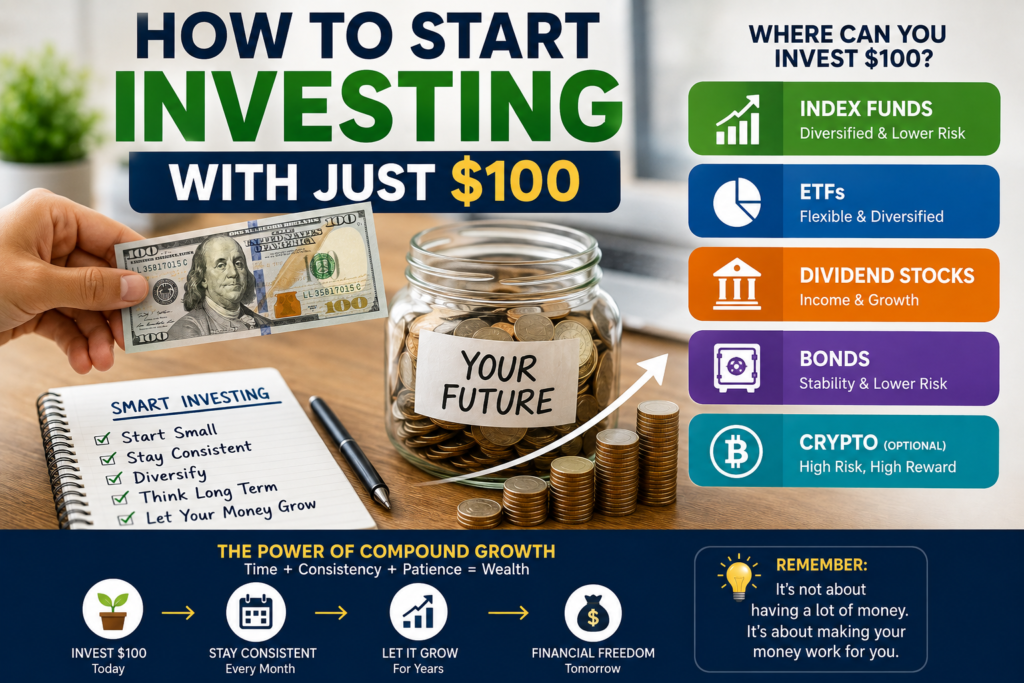
How to Start Investing With Just $100 Without Making It Complicated
One mistake beginners often make is assuming that a small portfolio needs to be complicated.
It doesn’t.
If you only have $100 available, you don’t need ten stocks, five ETFs, cryptocurrency, bonds, and several different accounts.
In fact, adding too many investments can make it harder to understand what you’re actually doing.
A simple portfolio can be easier to monitor and understand.
For someone researching How to Start Investing with Just $100, the first priority should be understanding the investment rather than collecting as many investments as possible.
Ask yourself:
- What exactly am I buying?
- What does this investment own?
- How does it make money?
- What risks could cause it to fall?
- What fees am I paying?
- How long do I expect to hold it?
If you can’t answer these questions, spend more time researching before investing.
Build a Simple $100 Investment Strategy
Let’s create a hypothetical beginner strategy.
Imagine you have $100 that you don’t need for immediate expenses.
Instead of looking for a stock that could double overnight, you decide to focus on diversification and long-term growth.
You might research a broad-market ETF or index fund that gives you exposure to many companies.
You could then invest your $100 and leave it alone while continuing to learn.
After your first month, you might contribute another $50.
Then another $50 the following month.
Over time, your portfolio becomes larger because you’re contributing new money instead of relying entirely on the performance of your original $100.
This is one of the most important ideas behind How to Start Investing with Just $100.
The first investment gets you started.
Your future contributions help build the portfolio.
How Compound Growth Works
Compound growth is one of the biggest reasons investors focus on starting early.
Imagine you invest $100 and your investment earns a return.
Instead of withdrawing that return, you leave it invested.
Future growth can then potentially occur on your original money as well as previous earnings.
This creates a snowball effect over long periods.
Of course, real investments don’t produce guaranteed returns every year. Some years can be positive, while others can be negative.
But the basic principle of compounding remains important.
Consider a hypothetical example where an investor starts with $100 and adds $50 every month.
After one year, the investor has contributed $700.
After five years, the contributions total $3,100.
After ten years, the contributions reach $6,100.
After twenty years, the contributions reach $12,100.
These numbers represent contributions only and don’t include investment gains or losses.
If the investments grow over time, the account could be worth more than the amount contributed. If investments perform poorly, the value could be lower.
That’s why investing always involves risk.
Why Starting Early Can Matter More Than Starting Big
Many people wait to invest because they believe they need a large amount of money.
They might say:
“I’ll start when I have $5,000.”
Then $5,000 becomes $10,000.
Then they decide they’ll start when they have $20,000.
Years can pass while nothing happens.
Learning How to Start Investing with Just $100 can help break that cycle.
Starting small allows you to gain experience while you build your savings.
You don’t have to wait until you feel wealthy.
You can start with what you can reasonably afford and increase the amount later.
The earlier you learn good financial habits, the more time you potentially have to benefit from them.
Should Beginners Invest in Individual Stocks?
Individual stocks can be attractive because they are easy to understand at a basic level.
You buy shares in a company because you believe the company can grow and become more valuable.
But choosing individual companies also requires more research.
Before buying a stock, consider:
Company Revenue
Is the company generating sales?
Profitability
Does the company consistently make money, or is it still operating at a loss?
Debt
Does the company carry a large amount of debt?
Competition
Does the business have a strong competitive position?
Valuation
Is the stock already priced extremely high compared with the company’s earnings or growth prospects?
Long-Term Outlook
Does the company have a realistic opportunity to grow over the next five or ten years?
These questions won’t guarantee that your investment will succeed, but they can help you make more informed decisions.
If you are learning How to Start Investing with Just $100, don’t buy a stock simply because its ticker symbol is trending online.
Are ETFs Better for Beginners?
There is no investment that is automatically “best” for every beginner.
However, ETFs can be appealing because one fund can contain many investments.
For example, a broad-market ETF could provide exposure to hundreds or even thousands of companies, depending on what it tracks.
That can be easier for someone who doesn’t want to research individual businesses.
However, ETFs can also be highly specialized.
An ETF focused entirely on one industry may not provide the same level of diversification as a broad-market fund.
So don’t assume every ETF is diversified just because it contains multiple holdings.
Read the fund’s description and holdings before investing.
What About Dividend Investing?
Dividend investing is another strategy beginners often encounter.
Some companies distribute part of their profits to shareholders in the form of dividends.
For example, if you own shares in a company that pays dividends, you may receive periodic payments.
However, dividends are not free money.
A company can reduce or eliminate its dividend.
The stock price can also fall.
For this reason, don’t choose an investment simply because it has the highest dividend yield.
If you’re exploring How to Start Investing with Just $100, focus on the overall investment rather than one attractive number.
Consider the company’s financial health, dividend history, debt, earnings, and valuation.
Should You Invest $100 in Cryptocurrency?
Cryptocurrency is another option that beginners may consider.
Digital assets can be purchased in small amounts, making them accessible to people with limited capital.
But accessibility doesn’t mean low risk.
Cryptocurrency prices can move dramatically in short periods.
A $100 investment could potentially rise quickly, but it could also lose a significant portion of its value.
If you decide to research cryptocurrency as part of your investment strategy, understand exactly what you’re buying.
Don’t assume that a cryptocurrency priced at $0.05 is automatically cheaper or better than one priced at $500.
The unit price alone doesn’t tell you the total value or quality of a project.
For beginners learning How to Start Investing with Just $100, cryptocurrency should be approached with a clear understanding of its higher volatility and risks.
Don’t Borrow Money to Invest Your $100
If you’re trying to figure out How to Start Investing with Just $100, don’t make the mistake of borrowing additional money just to increase your investment.
Using borrowed money can magnify both profits and losses.
Imagine you invest $100 of your own money and borrow another $400.
Now you have $500 invested.
If the investment falls 30%, the portfolio loses $150.
You still owe the borrowed money.
For a beginner, investing your own money is usually much easier to understand and manage than adding leverage.
Watch Out for Investment Scams
Small investors can be especially vulnerable to scams because scammers often make their offers sound simple.
You might see promises such as:
- Guaranteed daily returns
- Risk-free cryptocurrency profits
- Double your money in one week
- Secret stock recommendations
- Guaranteed monthly income
- Exclusive investment opportunities
Real investments don’t come with guaranteed high returns and zero risk.
If someone is pressuring you to send money immediately, promising unrealistic profits, or refusing to explain how the investment works, walk away.
Learning How to Start Investing with Just $100 also means learning how to protect that $100.
Understand Investment Fees
Fees might not seem important when you’re investing only $100.
But they become more meaningful as your account grows.
Suppose an investment charges a management fee every year.
That fee may seem tiny when your account is $100.
But if your portfolio eventually grows to $10,000, $50,000, or $100,000, the same percentage fee can have a much larger dollar impact.
Before investing, check:
- Trading fees
- Fund expense ratios
- Account maintenance fees
- Withdrawal fees
- Currency conversion costs
- Other platform charges
A low-cost investment isn’t automatically better, but unnecessary fees can reduce long-term returns.
Don’t Check Your Portfolio Every Five Minutes
Once you make your first investment, you may feel tempted to check it constantly.
You might open your investment app before breakfast.
Then again at lunch.
Then before bed.
Every small movement can start affecting your mood.
Long-term investing usually doesn’t require constant monitoring.
If your investment strategy is based on a five-, ten-, or twenty-year horizon, a one-day price movement shouldn’t automatically change your plan.
This doesn’t mean you should ignore your portfolio completely.
Reviewing your investments periodically can be useful.
Just don’t let every market headline push you into an emotional decision.
How to Start Investing With Just $100 and Keep Adding Money
The most powerful part of How to Start Investing with Just $100 isn’t necessarily the first $100.
It’s what happens next.
Suppose you begin with $100.
Then you add:
Month 1: $50
Month 2: $50
Month 3: $50
Month 4: $50
You’ve now added another $200.
Your original $100 has become part of a $300 contribution total, before considering investment gains or losses.
Continue this process for several years and your contributions can become much more substantial.
This is why regular investing can be more important than trying to predict exactly when the market will rise or fall.
Create a Monthly Investing Budget
A simple monthly investing budget can help you stay consistent.
Start by looking at your income and essential expenses.
Then consider how much you can comfortably save.
For example, you might decide that $50 per month is realistic.
If your income changes, you can adjust the contribution.
There’s no need to compare your investing amount with someone else’s.
Someone earning $3,000 per month may have a completely different budget from someone earning $7,000.
The goal of How to Start Investing with Just $100 is not to compete with other investors.
It’s to create a financial habit that works for you.
What If You Can Only Invest $10 a Month?
That’s okay.
You don’t need to invest $100 every month just because your first investment was $100.
If $10 is what you can realistically afford, start with $10.
If you can later increase it to $25, do that.
Then perhaps $50.
The important thing is consistency.
Small contributions can accumulate over long periods.
Waiting until you can invest a large amount may mean losing valuable time.
How Inflation Affects Your Money
There’s another reason people choose to invest.
Over time, inflation can reduce the purchasing power of money.
If prices rise, the same $100 may not buy as much in the future as it does today.
This doesn’t mean investing automatically protects you from inflation.
Different investments perform differently, and some can lose money.
But understanding inflation is important when thinking about long-term financial planning.
Your goal shouldn’t simply be to have more dollars.
You also want your money to retain or potentially increase its purchasing power over time.
How to Start Investing With Just $100 for Retirement
If you’re investing for retirement, your time horizon may be several decades.
That long timeline can change how you think about market volatility.
A young investor might have many years to recover from temporary market declines.
Someone approaching retirement may have a much shorter time horizon and different risk considerations.
This is why retirement investing shouldn’t be based only on age or a generic internet recommendation.
Think about:
- Your expected retirement date
- Current savings
- Future income
- Employer retirement benefits
- Risk tolerance
- Other investments
- Expected expenses
If you’re in the United States, you may also have access to tax-advantaged retirement accounts such as a 401(k) or IRA, depending on your circumstances.
Other countries have their own retirement systems and tax rules.
A Practical $100 Investing Plan for Beginners
Let’s put everything together.
If you want a simple framework for How to Start Investing with Just $100, consider these steps.
Step 1: Protect Your Basic Finances
Make sure the $100 isn’t needed for an immediate expense.
Step 2: Choose a Goal
Decide whether you’re investing for long-term wealth, retirement, or another goal.
Step 3: Research an Investment Platform
Compare reputable platforms and understand their fees.
Step 4: Learn About Diversification
Understand the difference between investing in one company and investing across many companies.
Step 5: Research the Investment
Read about the fund or company before buying.
Step 6: Invest the $100
Once you’ve done your research and are comfortable with the risk, make your first investment.
Step 7: Keep Learning
Don’t stop researching after your first purchase.
Step 8: Add Money Regularly
Choose an amount that fits your budget.
Step 9: Review Periodically
Check your portfolio occasionally and make sure it still matches your goals.
Step 10: Stay Patient
Don’t let every market movement change your long-term strategy.
Five Mistakes That Can Hurt Your First $100
Mistake #1: Chasing Guaranteed Returns
There is no legitimate investment that can promise high returns without risk.
Mistake #2: Investing Based on a Social Media Post
A viral post is not a substitute for research.
Mistake #3: Putting Everything Into a Hype Investment
An investment can be popular and still be extremely risky.
Mistake #4: Selling in Panic
A temporary decline doesn’t automatically mean you made a bad investment.
Mistake #5: Never Investing Again
Putting $100 into an account once and never contributing again limits the potential of your strategy.
The biggest lesson from How to Start Investing with Just $100 is that consistency matters.
How Long Should You Keep Your Investment?
There’s no universal holding period.
The right timeframe depends on what you’re investing in and why you’re investing.
A diversified long-term portfolio may be held for many years.
A short-term financial goal may require a completely different approach.
Don’t invest with the assumption that every investment should be held forever.
Instead, establish your goal and review whether the investment continues to make sense.
How to Start Investing With Just $100 Without Becoming an Active Trader
You don’t need to become a day trader to be an investor.
Day trading involves buying and selling investments frequently to attempt to profit from short-term price movements.
It can be extremely difficult and risky, particularly for inexperienced investors.
Long-term investing takes a different approach.
Instead of trying to predict what will happen tomorrow, you focus on the long-term potential of your investments and your own financial goals.
For many beginners, this approach can be easier to maintain.
Your $100 Investing Mindset Matters
Money is only one part of investing.
Your behavior matters too.
If you constantly chase whatever investment is performing best, panic whenever prices fall, and change your strategy every few weeks, it can become difficult to build a consistent plan.
A better mindset is to accept that uncertainty is part of investing.
Some investments will perform well.
Some will perform poorly.
Markets will rise.
Markets will fall.
You won’t always know what happens next.
The goal is to create a strategy that doesn’t depend on perfect predictions.
What Your First $100 Can Teach You
Your first investment can teach you several valuable lessons.
You’ll learn how to place an investment order.
You’ll see how market prices change.
You’ll understand what fees look like.
You’ll experience market volatility.
You’ll learn whether you can tolerate temporary losses without panicking.
You’ll also begin to understand how saving and investing work together.
These lessons can become much more valuable as your portfolio grows.
That’s why How to Start Investing with Just $100 is not simply a question about where to put $100.
It’s a question about how to develop a sustainable investing habit.
Final Thoughts: Your First $100 Is Only the Beginning
Learning How to Start Investing with Just $100 doesn’t mean you need to become a professional investor.
You don’t need a complicated portfolio.
You don’t need to predict the market.
You don’t need to find the next explosive stock.
You simply need to start with a sensible amount, understand what you’re buying, and develop a long-term plan.
Your $100 may feel small today, but it can be the first step toward a much larger financial habit.
The most important thing is what happens after that first investment.
If you continue saving, keep learning, control unnecessary fees, diversify appropriately, and invest consistently according to your goals, you can gradually build a portfolio that is far larger than your original $100.
So, if you’ve been asking How to Start Investing with Just $100, remember this:
Start small. Learn continuously. Invest responsibly. Stay patient.
Your first $100 doesn’t have to be impressive.
It just has to be your beginning.
Disclaimer: This article is for educational purposes only and should not be considered personalized financial advice. Investments involve risk, including the possible loss of principal. Consider your own financial circumstances and research investments carefully before making financial decisions.
Keep Learning Before You Invest
Starting with $100 is only the first step. As you become more comfortable with investing, it’s worth learning about different platforms, fees, investment options, and the tools available to beginners. If you’re still deciding which platform to use, check out our detailed guide on Best Investment Apps for Beginners in 2026 to compare some beginner-friendly options.
Best Investment Apps for Beginners in 2026
Learn More About Smart Investing
Before putting your money into any investment, take some time to understand risk, diversification, and your investment goals. The U.S. Securities and Exchange Commission’s Investor.gov also provides helpful educational resources for people who are new to investing, including information about different investment products and diversification.